
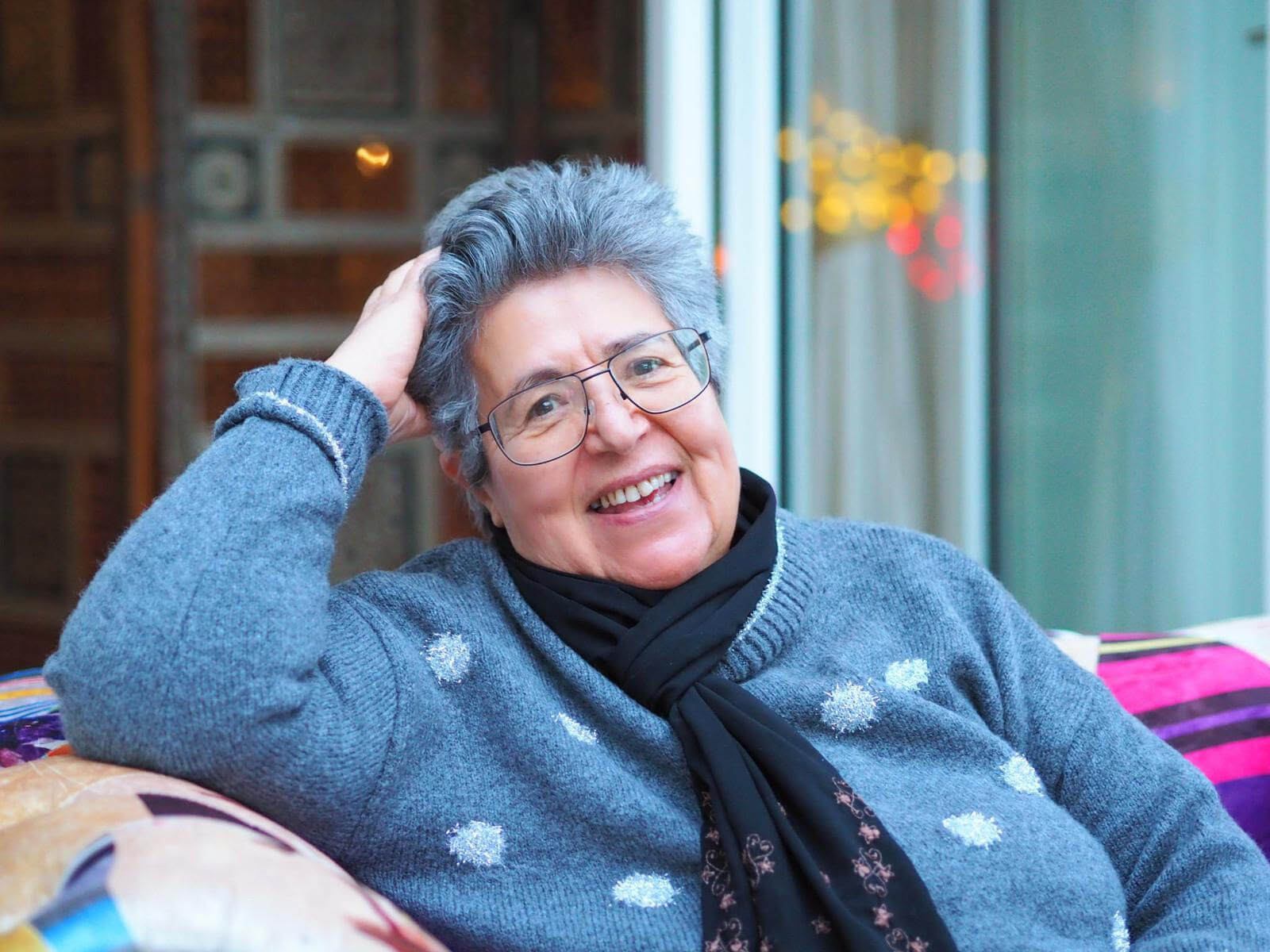
Fadwa Ahmed Affara
MA, MSc, RGN, SCM, RNT.
Aden Protectorate 1942 – Edinburgh, Scotland 2025.
Fadwa Affara, our cherished friend and Co-Chair of the Africa Action Network for
Nurses, passed away peacefully in her care home in Scotland, surrounded by her
loving family. Fadwa was a global nurse leader and an extraordinary role model
personally and professionally, touching the lives of so many throughout the world.
Always positive and caring, available and ready to help and with an extraordinary
intelligence, she was a mentor to many and left a rich legacy in nursing education,
regulation, and governance across countries and health systems.
We are all privileged to have had this remarkable person in our lives.
Fadwa’s story is remarkable:
I was born in 1942 in the Aden Protectorate, at the time a British colony. At the age
of 11, I was sent to Edinburgh to be educated as suitable education for girls past the
primary level was not available. My father was a Church of Scotland medical
missionary and a graduate in Medicine from Edinburgh University.
University and Nursing Education
The enduring memories of my university education was that of being the focus of
critical and somewhat sceptical scrutiny from both the academic and nursing
authorities. I was part of a second group of students undertaking an MA while
concurrently pursuing a Registered Nurse qualification. In the early 1960s nursing
was significantly hostile of what they called ‘academic’ nurses arising from doubts
that nursing care needed the intellectual and scientific rigour as well as critical
thinking and decision-making skills developed through academic study, and the
University was not yet prepared to recognise nursing at a degree level subject.
The university years left little time for much beyond study as I had to meet the
demands of both programmes, including spending eight weeks of the summer
breaks on the wards of Edinburgh Royal Infirmary learning the caring role. After
obtaining the MA I had two more years of nursing study and practice experience as a
student to qualify as a registered general nurse. Three years later, I qualified as a
state-certified midwife. However, I do recall with pleasure two holidays arranged
through student services to Denmark and Positano, Italy, as well as a stimulating
week acting as a rapporteur at my first international nursing conference in Athens.
Nearly 10 years later, I returned to Edinburgh University to be in the first group to
complete an MSc in nursing education and to find that nursing was no longer just an
add-on programme but a recognised and growing field of academic study and
research.
Alumni wisdom
Regard what was learned and experienced at university as being only the basic tools
which need to be added to and honed for a lifetime of growth, both personal and
professional. Do not be afraid to take risks using judgement and a critical regard and
explore opportunities to innovate and create a better reality.
Professional Nursing Career
I spent the first 15 years of my professional career in clinical nursing and midwifery in
Edinburgh, Glasgow, and as a volunteer at the French Hospital in Nazareth. There I
practiced as a midwife as well as teaching in a newly established nursing school. It
was a challenge as the language of instruction was French and teaching followed the
experiential rather than didactic teacher-led model. It was daunting having had no
teaching experience and struggling to do so in a language I had last studied at
school.
After completing the MSc, I took up a lecturing position in Dundee teaching the first
group in the newly launched BSc in Nursing. In Dundee I came in contact with
healthcare professionals on World Health Organization (WHO) fellowships, which
directly resulted in a decision to work internationally, taking me first to Bahrain as
Chairperson of the Nursing Division at the College of Health Sciences, then to
Geneva as consultant with the International Council of Nurses (ICN), a federation of
over 120 national nurses associations. At ICN my first responsibility was directing
and implementing a project involving 87 countries across five world regions designed
to assist countries in achieving a necessary reform of nursing professional
regulation.
What I learned was that nurses across the globe faced many similar challenges.
These only differed in intensity, the political and social contexts and the degree of
control nurses had over their own destiny.
I worked internationally for 31 years, first with ICN and latterly as an independent
consultant, participating at the international and country levels in a variety of
activities, particularly in the education regulation and advanced practice fields.
Activities included assisting countries review and develop proposals for regulatory
reform; working with WHO on developing regional nursing education standards;
establishing a mobile library of current nursing and health sciences knowledge
housed in a tin trunk for nurses working in areas where access to current information
was poor; collaborating with the other international experts on ICN publications;
setting up networks with international colleagues to support ICN members in areas
such as regulation, and advanced practice; and managing the development of the
‘Classification for Nursing Practice’, now available in 18 languages.
What I learned was that nurses across the globe faced many similar challenges.
These only differed in intensity, the political and social contexts and the degree of
control nurses had over their own destiny. Although there has been significant
improvement to date, too often nurses were and are in some cases excluded from
participation in the decision and policy making processes that directly affected their
work. A challenging part of my role at ICN and later was to help nurses develop skills
and strategies to become recognised, legitimate participants in those processes that
directly affect their work life, education and status.
Life with AAN and Covid-19
I assisted three international colleagues to establish ‘The Covid-19 Africa Action
Network for Nurses & Nurse-Midwives’ and the ‘Protect Nurses. Save Lives’
campaign. We were all living in countries with functioning and well-resourced
healthcare systems while our contacts in low-resource settings in eastern and
southern Africa reported that nurses and nurse-midwives on the front lines were too
often working without personal protective equipment (PPE), greatly risking
themselves and families to infection and physical and psychological violence. We set
up a crowdfunding site and began to raise funds from other donors to provide
identified country partners with modest grants for projects for the procurement, local
production, and provision of PPE.
Several other initiatives were launched, including establishing evidence-based
specifications for artisanal reusable PPE; live, online Q&A sessions linking doctors in
China, who were first responders during the Wuhan stage of the pandemic, to
healthcare professionals in Eswatini, Kenya, Lesotho, Malawi, Tanzania and
Uganda. Also working with the World Continuing Education Alliance, the network
promoted free access to Covid-19 education through mobile technology.